ICE, the US Immigration and Customs Enforcement, has been a common topic lately in the news and in the lives of millions around the country.
While originally founded in 2003, it was created for enforcing border control. Recently however, it has been much more militarized under command of the Trump administration. ICE funding has exponentially increased under the One Big, Beautiful Bill Act, which was signed into law July 2025. This bill defunded many different federal programs and brought larger tax cuts. This bill also put forward $75 billion to ICE operations, according to an NPR website.
This funding is projected to continue until 2029, with an annual budget of roughly $10 billion. Increased militarization and agent deployment was implemented when 3,000-4000 ICE officers deployed to Minnesota in December 2025, as well as the thousands of other officers in several other states.
While opinions on the matter are, at least to say, mixed, there is no doubt that ICE has rapidly expanded in the past couple of years. ICE has focused primarily on towns with high amounts of immigrants and, according to ICE’s official statistics page, their arrest rates have gone up, with 8,381 arrests in 2024 to 12,776 in 2025. The statistics read out to “about 400 arrests per day,” as of 2025, according to the ICE official website.
Missoula’s own law enforcement has been very clear to separate themselves from the ICE agents.
According to the Missoula City website, a quote from Chief Colyer, the head of police in Missoula, says, “I am concerned that when people see federal immigration enforcement officers acting in ways they don’t approve of, they will lump together all law enforcement as untrustworthy, and that will affect our officers.”
He continued by saying that all of his police officers are obligated to intervene if they see law enforcement using excessive force.
Since this applies to all area police officers in Missoula, this also applies to our own school resource officer.
As an officer at a high school, do their perspectives change if it’s not protecting a community but a whole school?
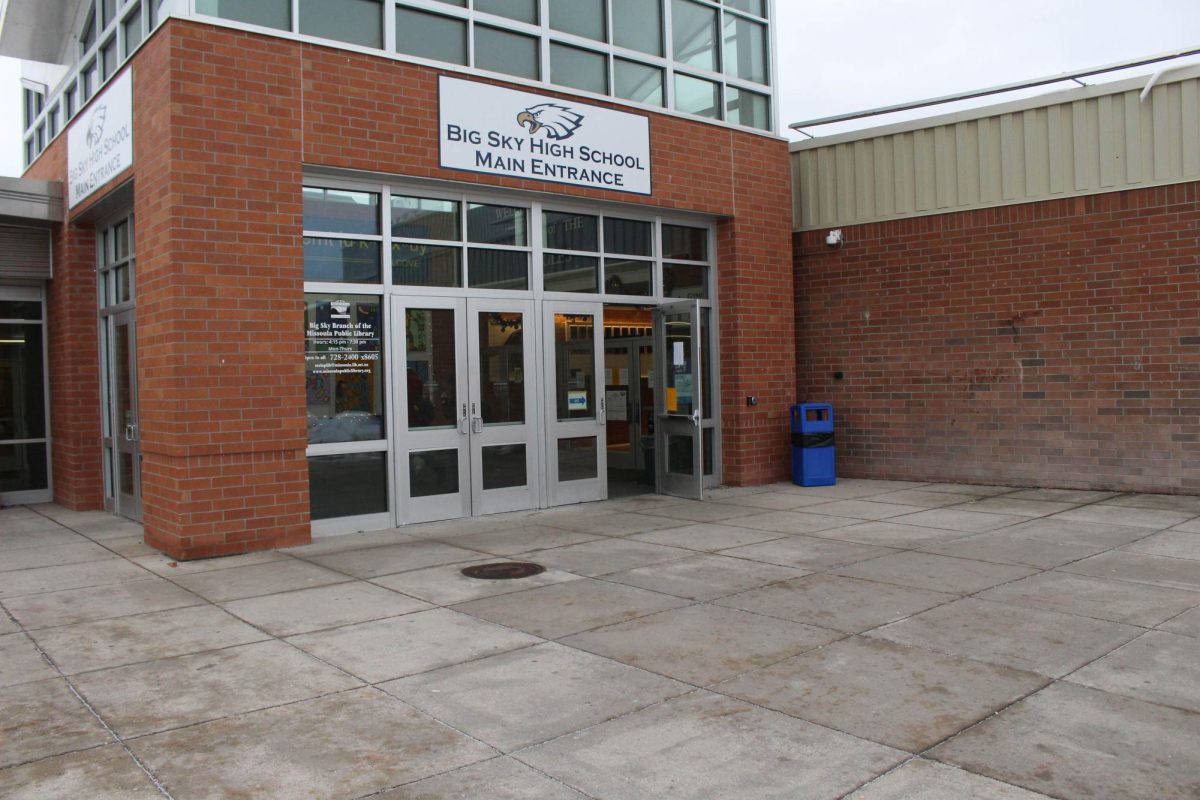
Officer Cameron, the SRO at Big Sky High School, says, “We don’t enforce any federal immigration laws. We enforce state and municipal laws, so we wouldn’t necessarily be assisting any [ICE] operations unless they request a sort of emergency assistance.”
In terms of legal obligations with ICE presence in school, Cameron continued, “We would treat them as any other law enforcement agency. We would normally try and make contact with them, see how we could be an intermediary to assist with any kind of communication. We wouldn’t be assisting them at all, kind of just acting as a point of contact if they needed anything from the Missoula Police Department.”
While Big Sky hasn’t directly been impacted by ICE as of early March, other schools across the country and even the state are definitely affected, and have been a target of interest for some ICE officers and factions.
As per a federal law passed in January 2025 called the Revocation of Sensitive Locations Memorandum, legal authority was granted to enforcement actions at schools. This essentially means that ICE officers are able to commit arrests and searches towards undocumented immigrants at schools and churches.
With the looming threat of possible deportation, schools across the country have reported far fewer immigrant students enrolling within schools.
For example, according to a study done by PBS, Denver public schools has seen a significant drop of new to country students in 2025, with about 400 students enrolled compared to 1,500 the year before.
In our own capital, Helena, local law enforcement put out a statement in the Montana Free Press stating that they will only work with ICE agents under a court order, while Missoula itself saying they will not enforce federal immigration law.
It’s no longer a reality to ignore the existence of ICE in our country, and with realizations in schools and small town political figures recognizing this, how does a younger generation respond to this?
With the three high schools in Missoula, opinions within these schools are mixed. At one school, opinions heated enough for students to decide something needed to be done.
At Hellgate High School on January 20, roughly 200 students walked out around 2 pm and proceeded down Higgins Avenue to protest ICE, specifically the allegedly unlawful arrests that have taken place in states like Minnesota and killings of both Renee Good and Alex Pretti .
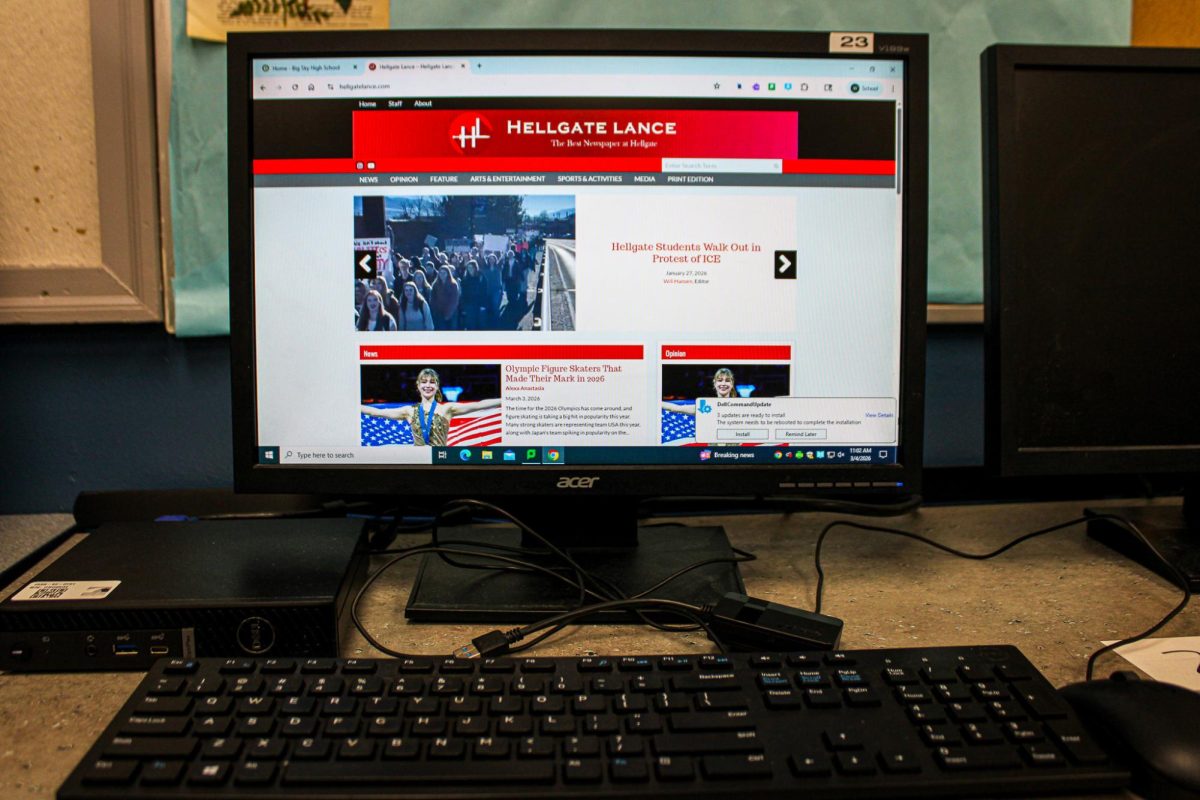
The protest was peaceful, and was organized by students. Once on Bear Tracks Bridge, Hellgate student Cora Barnes gave a short speech to the students gathered there, according to Hellgate’s official news site, The Hellgate Lance.
In a recent phone interview, Hellgate student Eb Billingsley gave a student perspective of the walkout.
“There’s definitely been a lot of anger in conversations around me about ICE. Mostly just about the way that it’s been happening is un-okay and definitely unethical,” Billingsley said.
“I think that people really started to grasp how drastic the situation was probably around the time when Renee Nicole Good was killed.”
Protests are normally a sign to go against something a large group of people feel is unjust. But protests in school are sometimes known to be used just as an excuse to get out of class.
When considering the recent ICE protests, Billingsley didn’t think so.
“A lot of the students didn’t just leave. They stayed for about an hour, a lot of them walked down to the courthouse and stayed at the bridge downtown,” Billingsley said.
When asked about Hellgate’s walkout and the potential for a similar response at Big Sky, Officer Cameron said , “They are using an expression of their first amendment right-freedom of speech.”
A handful of students did briefly walk out at Big Sky on the same day that Hellgate had theirs, but there was no student-organized, schoolwide protest.
Big Sky’s vice principal, Jennifer Courtney, expressed similar thoughts to Cameron about students protesting social issues.
“Voice and choice is really important. This topic in particular I think is important for staff not to get in their way and to let students walk out.”