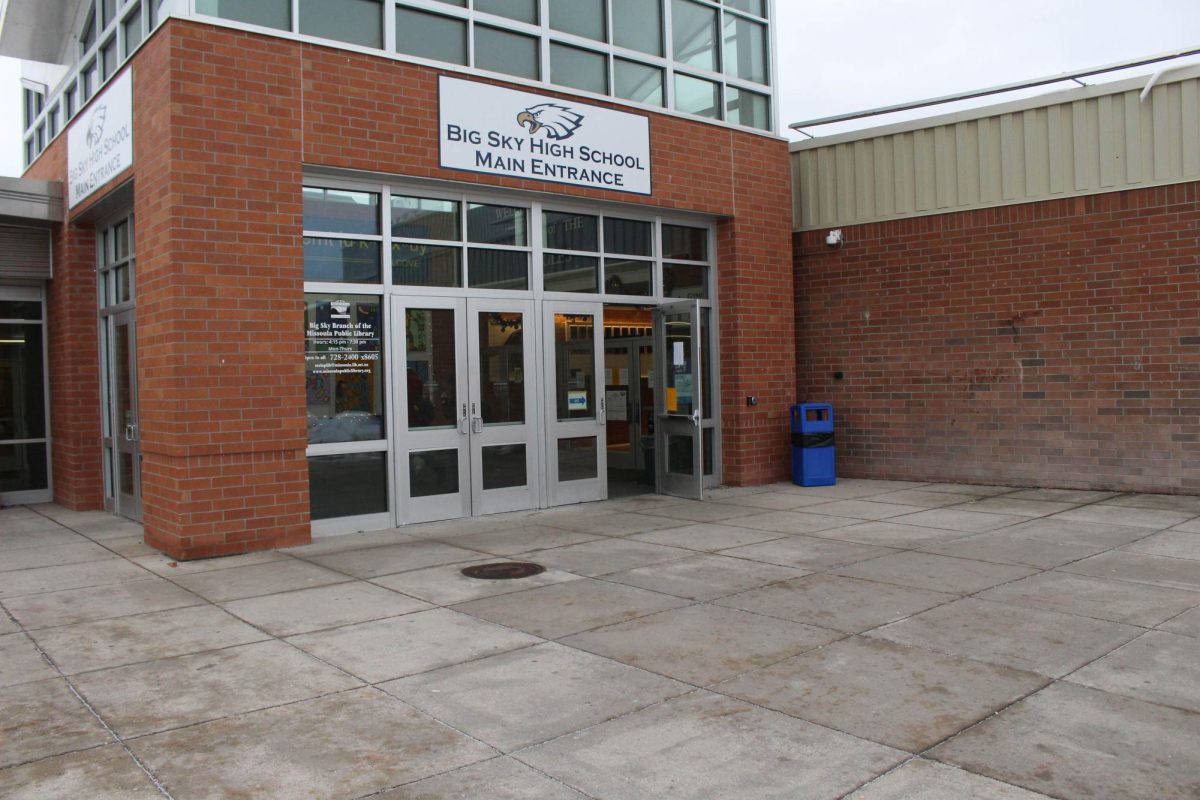
As of the start of the 2025-26 school year, therapy dogs are no longer allowed in any Missoula County Public Schools (MCPS) building, according to school officials.
Big Sky High School staff in particular are very upset with the new policy, as there are many therapy dogs that have attended school with staff over the years. One of the dogs, Pickles, has been at the school for eight years.
“I’m not able to establish relationships with students like I used to. I was a soft place to fall for a lot of kids,” said Janice McGraw, administrative assistant for Big Sky’s special services department and owner of Pickles.
Pickles has become a staple of Big Sky after being at the school for eight years. Having a dog go to school for that long, like humans, they can start to form a schedule. McGraw said that in the morning Pickles gets really excited thinking she is going to the school. McGraw said it’s heart breaking not being able to take her in with her, for Pickles and students.
Big Sky’s principal, Jennifer Courtney, who is a large advocate for having therapy dogs at the school, first got the news in late August during an in-person, all district conference. Courtney feels terrible about the new change, saying that Big Sky didn’t have any issues with therapy dogs.
When asked what prompted the change, Courtney stated she had heard that CS Porter had an untrained dog that was brought into the school and was defecating on the floor. She also said that there were problems throughout the district having faculty members bringing in their untrained and unlicensed dogs, causing issues within the building, such as getting into garbage.
MCPS officials did not respond to a request for comment before this story was published.
Teachers were notified of the change on August 13 through an email from Courtney after she was notified by HR and the superintendent.
But while many Big Sky staff members are upset by the change, there is one Big Sky teacher in particular who is voicing their concerns: French teacher Sarah Kries.
Kries has spoken at board meetings, suggesting that if you have a licensed and trained dog, then that should be allowed in school. Kries has a licensed therapy dog named Dale who has been coming to the school very frequently since Christmas time last year. Dale was in the classroom for up to four days a week.
There is a very distinct difference between a therapy dog and a service dog. A therapy dog must be invited into the building by Courtney after completing training through a certified program, classes, and a final test. Therapy dogs are for a larger population of individuals such as schools, and hospitals, like how Dale is in the classroom with 10-20 kids per class. Service dogs, on the other hand, are geared for individuals and their specific needs.
There is only one service dog within the school, and that dog is Sophie. Sophie is Amy Miller’s service dog. Miller teaches English at Big Sky and is wheelchair bound, so Sophie is trained to be able to open doors and to pick things up for her as needed.
Service dogs have jobs like seizure alert, or seeing eye dogs. Service dogs are legally protected at the federal level, so MCPS can never say service dogs aren’t allowed within schools.
Kries said she saw a large impact after having therapy dogs removed from the school, saying she sees a lot more anxiety among students.
“Kids told me they took French just because Dale was going to be in here,” Kries explained.
“I had a kid in my class have a panic attack, Dale noticed and gave the student what is called pressure therapy by putting his head on their lap.”
Beyond Kries, there are many other faculty in the building who had brought therapy dogs to the school. A very common place to find these dogs was the counseling center, as two different counselors both brought in therapy dogs when they were allowed.
The two counselors at Big Sky who were bringing in therapy dogs of their own were Molly Wilson and Heather Williams. Williams has been working at Big Sky for 12 years through teaching and counseling. Williams said her therapy dog, Lucy, had been coming to the school for about a year and a half.
Lucy would come in about three days a week. Williams said if she came in anymore she would notice Lucy would get tired and would sleep the whole next day.
Williams stated she felt devastated when hearing about the new policy. “I feel like maybe dogs across the district were given a bad name because standards weren’t being held,” Williams said.
Williams said she noticed an effect on students, saying that many students were bummed out when they heard they couldn’t come in to see Lucy.
Having a therapy dog in the room was also good for Williams, as she explained that Lucy brought a better tone for parents and meetings.
“There were tense meetings where Lucy would come over and sit between the parent and the kid, and it completely changed the dynamic of the meeting,” Williams said.
Williams also went on to say that when parents would walk in, they would be a bit tense or nervous. Lucy would instantly come to greet them, and that changed the mood of the meeting for everyone.
Just like how Pickles would think she is coming to school, Lucy would also get into a rhythm thinking she was about to go to school. “At the beginning of the school year, when I’d put my stuff on, she’d be at the door ready to go. Now she just sits there and stares at me,” Williams said.
Overall, all the teachers and counselors that brought in therapy dogs all feel the same way, and Kries and Courtney are both very adamant about having students reach out to the school board through showing up to board meetings or writing to the board about bringing therapy dogs back.
Williams wrapped up by saying, “It was never about me or my dog. My argument for bringing her back would be for the kids and the families. If it changed back, I would love to have her here again.”